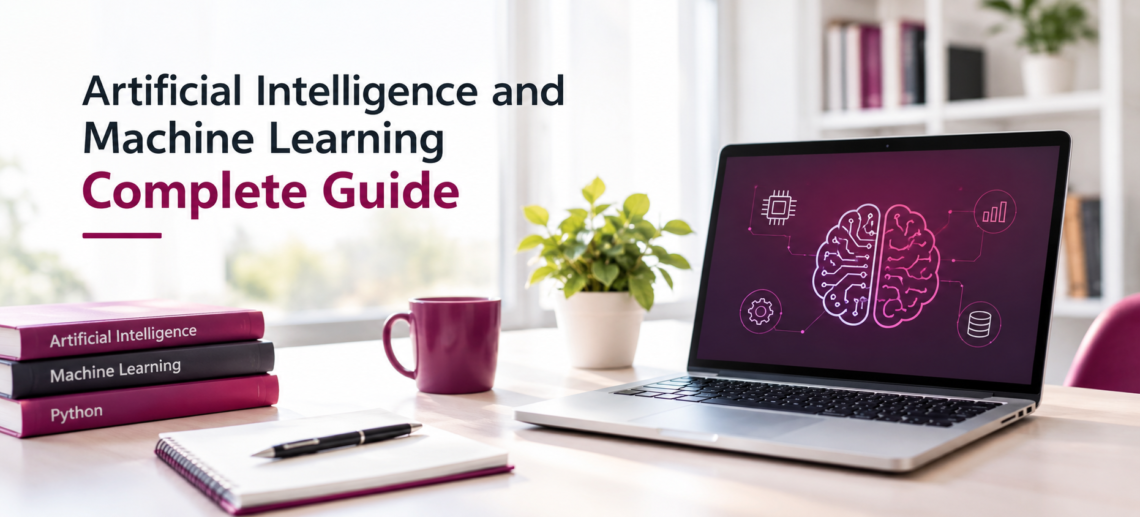
Artificial Intelligence and Machine Learning are becoming part of everyday life. When Netflix recommends a film, a voice assistant answers a question, or a banking app detects an unusual transaction, these technologies may be working behind the scenes. They help computers process information, recognise patterns, and perform tasks that would otherwise require human input.
Although AI and ML are often used together, they do not mean the same thing. Artificial intelligence is the broader field of creating systems that can perform tasks associated with human intelligence, while machine learning is one approach that allows computers to learn patterns from data and use them to make predictions or decisions.
Understanding the difference between these terms is a useful first step for anyone interested in technology, data, or automation. This guide explains what AI and ML mean, how they work, where they are used, which skills beginners need, and how to start learning them from scratch.
If you are new to AI and machine learning, deciding what to learn first can feel confusing. Understanding the basic concepts, choosing the right starting point, and building your skills step by step can make the process easier. Read our guide on where to start with AI and ML to explore how beginners can approach these subjects.
Table of Contents
What Is Artificial Intelligence?
Artificial Intelligence, commonly called AI, is a field of technology focused on creating computer systems that can perform tasks that normally require human intelligence. These tasks may include understanding language, recognising images, solving problems, identifying patterns, and making decisions based on available information. For example, a traditional computer program follows instructions written by a developer. An AI system may go further by interpreting a question, identifying relevant information, and generating a response based on its training and design.
AI does not necessarily mean that a machine thinks or understands the world exactly as a human does. Instead, it refers to systems designed to carry out particular tasks intelligently. Some systems follow predefined rules, while others use machine learning or other techniques to produce their results. AI is also broader than machine learning. It includes different approaches to solving problems, such as rule-based systems, search and planning methods, language processing, computer vision, and learning from data.
How Is AI Used in Everyday Life?
AI is already used in many digital services and everyday activities. You may interact with it several times a day without noticing the technology behind it.
- Recommendation systems: Streaming platforms and online shopping websites suggest films, products, music, or other content based on your activity, preferences, and patterns found across users.
- Voice assistants: Voice assistants interpret spoken requests to help users set reminders, search for information, play music, or control connected devices.
- Image recognition: Photo applications can identify faces, organise pictures by subject, and recognise objects in images. Similar technology can help businesses inspect images for specific features.
- Fraud detection: Banks and payment services can analyse transaction patterns to identify activity that appears unusual and may require further checks.
- Chatbots: Customer support systems can answer common questions, guide users through processes, and help them find relevant information.
- Personalisation: Websites and applications can adjust the content, recommendations, or suggestions shown to different users based on their preferences and behaviour.
These examples illustrate how AI can make digital services more responsive and useful. However, AI systems can still make mistakes, produce inaccurate results, or reflect problems in the data used to develop them. Human oversight remains important, especially when decisions affect people’s finances, safety, or access to services.
What Is Machine Learning?
Machine Learning, or ML, is a branch of Artificial Intelligence that enables computers to learn patterns from data and use those patterns to make predictions or decisions. Instead of requiring a developer to write a separate rule for every possible situation, an ML system is trained using examples. It identifies relationships within those examples and uses what it learns to process new information.
Consider an email service that needs to identify spam. It would be difficult to write a complete set of rules covering every possible spam message because senders constantly change their wording, links, and techniques. A Machine Learning model can learn from examples of spam and legitimate emails, then estimate whether a new message is likely to be spam.
The model does not simply memorise a fixed list of messages. Its purpose is to identify patterns that may also be useful when it encounters messages it has not seen before.
Traditional Programming vs Machine Learning
Traditional programming and machine learning solve problems in different ways.
In traditional programming, a developer writes explicit instructions that tell a computer how to handle a situation. The program applies those instructions to the information it receives and produces an output.
In Machine Learning, developers provide relevant data and choose a suitable learning method. During training, the model identifies patterns that help it produce the required output. The model can then use those learned patterns when processing new data.
For example, a traditional program might flag a transaction whenever its value exceeds a fixed amount. An ML system could examine several characteristics, such as transaction value, location, timing, and previous activity, to estimate whether the transaction appears suspicious.
Neither approach is automatically better in every situation. Fixed rules can be more suitable when requirements are clear and consistent. Machine Learning can be useful when patterns are complex and difficult to describe through a manageable set of rules.
How Does Machine Learning Work?
Machine Learning generally follows a sequence of steps. The exact process depends on the problem, but the main stages are similar across many applications.
1. Data collection
The process begins with data relevant to the problem. This might include past sales, customer transactions, medical images, product reviews, or examples of spam emails. The data needs to be suitable for the task and sufficiently reliable to support useful learning.
2. Pattern identification
The learning method examines the data to identify relationships, similarities, differences, or other useful patterns. For example, sales data may show that demand changes according to the month, product category, or price.
3. Training
During training, the model adjusts its internal parameters to learn from the available examples. The aim is to produce a model that performs well on the task rather than simply memorising the training data.
4. Prediction
After training and evaluation, the model can process new information. It might predict future sales, classify an email, identify an object in an image, or estimate the likelihood of a particular outcome.
5. Feedback and improvement
The model’s performance can be checked against known outcomes or new observations. If it makes too many errors, the data, model, or learning process may need to be improved. Some systems are retrained periodically, while others use more frequent updates depending on their design.
For example, a retailer could use historical sales data to estimate demand for the next month. The business could compare the predictions with actual sales and use the findings to improve future forecasts.
Machine Learning does not automatically become more accurate simply because more data is added. Data quality, relevance, model selection, and proper evaluation all affect the results.
AI vs Machine Learning: What Is the Difference?
Artificial intelligence and machine learning are closely related, but they describe different things. AI is the broader field, while ML is one of the approaches used to develop intelligent systems.
| Artificial Intelligence (AI) | Machine Learning (ML) |
| A broader field focused on intelligent behaviour in computer systems | A subset of AI focused on learning patterns from data |
| Can use rules, search, planning, learning, and other approaches | Uses data to learn patterns that support predictions or decisions |
| Includes multiple technologies and methods | Focuses specifically on learning from examples or data |
| Can be used to build systems that perform intelligent tasks | Can help AI systems adapt their outputs to patterns found in data |
A useful way to understand the relationship is to think of AI as the larger category and ML as one part of it.
For example, an AI-based customer support system might use predefined rules to direct users to the correct department. Another system might use machine learning to classify customer messages based on their content. Both can form part of an AI solution, but they use different approaches.
Not every AI system relies on machine learning, and not every machine learning model needs to be part of a large AI application. The technologies are related, but their roles depend on the problem being solved.
What Are the Main Types of Machine Learning?
Machine Learning is commonly grouped into three main types: supervised learning, unsupervised learning, and reinforcement learning. Each approach learns from information in a different way and is suited to different kinds of problems.
Supervised Learning
Supervised Learning uses labelled examples. This means the training data includes both the input information and the expected answer.
For example, a model trained to identify spam emails might receive thousands of messages labelled as either spam or legitimate. By learning from these examples, it can identify patterns associated with each category and classify new messages.
Supervised Learning is commonly used for:
- Classification: Predicting a category, such as whether a transaction is suspicious or an email is spam.
- Regression: Predicting a numerical value, such as next month’s sales or the expected price of a property.
The key idea is that the model learns from examples where the correct outcome is already known.
Unsupervised Learning
Unsupervised Learning works with data that does not have predefined labels for the outcome being investigated. The system looks for patterns, similarities, or groupings within the data.
For example, a retailer may have customer purchase records but no existing customer segments. An unsupervised learning method could identify groups of customers with similar purchasing behaviour. The retailer could then study those groups to understand differences in buying habits.
Common applications include customer segmentation, grouping similar documents, and exploring patterns in large datasets.
Unlike supervised learning, the model is not given a correct category for every example. The useful patterns must be interpreted in the context of the problem.
Reinforcement Learning
Reinforcement Learning involves an agent learning through interaction with an environment. The agent takes an action, receives feedback in the form of a reward or penalty, and adjusts its behaviour to improve its results over time.
For example, a system learning to play a game may receive rewards for achieving goals and penalties for making poor moves. Through repeated interaction, it can learn which actions are more likely to lead to a successful outcome.
Reinforcement Learning is used in areas such as game-playing systems, robotics research, and certain control and decision-making problems.
The main difference is that the system learns from the consequences of its actions rather than relying only on labelled examples or finding patterns in an unlabelled dataset.
AI and Machine Learning in Real-World Industries
AI and ML are used across industries to process information, identify patterns, support decisions, and automate selected tasks. Their purpose varies depending on the needs of each business.
Healthcare
Healthcare organisations can use AI to help analyse medical images, organise patient information, and support clinical decision-making. Machine Learning models may identify patterns in medical scans or estimate risks based on relevant patient data.
These systems can help healthcare professionals review information, but their outputs require appropriate clinical evaluation. They are not a substitute for qualified medical judgement.
Finance
Banks, insurers, and other financial organisations use AI and ML for fraud detection, risk assessment, transaction monitoring, and customer support.
For example, a system can analyse transaction patterns to identify activity that differs from a customer’s usual behaviour. The result may trigger additional verification or a review by the organisation. A flagged transaction does not automatically prove fraud; it indicates that further checking may be needed.
Retail
Retail businesses can use Machine Learning to estimate demand, recommend products, and analyse customer purchasing patterns.
A retailer may study previous sales, seasonal changes, and product availability to forecast how much stock is likely to be needed. Better estimates can help businesses plan inventory and reduce the risk of overstocking or running out of popular products.
Manufacturing
In manufacturing, AI and ML can help monitor equipment, identify product defects, and support production planning.
For example, a system may analyse sensor readings from machinery and identify patterns associated with possible equipment failure. Maintenance teams can investigate these warnings before a problem causes an unexpected production stoppage.
Image-based inspection systems can also help identify visible defects in manufactured products, although the results depend on the quality of the images and the system’s ability to recognise relevant defects.
Marketing
Marketing teams use AI and ML to understand customer behaviour, organise audiences, personalise content, and estimate campaign performance. For example, a business may analyse previous campaign results to identify which audience groups are more likely to respond to a particular offer. Marketers can use these insights to plan campaigns and measure performance more effectively.
Personalisation should still respect customer privacy and the appropriate use of personal information.
Transportation
Transportation companies can use AI and ML for route planning, traffic prediction, demand forecasting, and vehicle monitoring.
A delivery business, for instance, may use traffic conditions, delivery locations, and historical travel times to help plan routes. This can support more efficient operations, although unexpected road conditions can still affect the outcome.
AI is also used in driver-assistance technologies and research into autonomous vehicles, where safety and reliable performance are essential.
Cybersecurity
Cybersecurity teams use AI and ML to analyse network activity, detect unusual login behaviour, identify suspicious files, and help prioritise potential threats.
A system may flag a login attempt that differs from a user’s normal activity or identify a pattern associated with malicious software. Security professionals can investigate the alert and decide what action is appropriate.
These systems can help process large volumes of information, but they may also produce false alarms or miss threats. They work most effectively as part of a broader security process.
What Is the Role of Python in AI and Machine Learning?
Python is one of the most widely used programming languages for AI and Machine Learning because its syntax is relatively readable and its ecosystem includes many tools for working with data, training models, and evaluating results.
For beginners, Python provides a practical way to move from understanding AI and ML concepts to applying them to actual datasets.
Python is commonly used for three main activities:
Working with data: Loading datasets, organising information, handling missing values, and preparing data for analysis.
Developing Machine Learning models: Applying learning methods to data, training models, and checking their performance.
Building AI applications: Connecting trained models to applications that classify information, make predictions, process language, or recognise images.
Several Python libraries support this work:
NumPy: Provides tools for numerical operations and working with arrays.
Pandas: Helps organise, clean, and analyse structured data.
Matplotlib: Supports the creation of charts for exploring data and presenting results.
Scikit-learn: Provides tools for common Machine Learning tasks, including model training, evaluation, and data preprocessing.
TensorFlow and PyTorch: Offer frameworks for building and training neural networks and other deep learning models.
Beginners do not need to learn every library at once. Understanding basic Python, working with a dataset, and learning the purpose of a few common tools is a more practical starting point. Programming becomes increasingly useful as projects become more complex. It allows learners to repeat tasks, process larger datasets, test different approaches, and understand how a model produces its results. However, someone can begin learning the basic ideas behind AI and ML before becoming an experienced programmer.
What Skills Are Needed to Learn AI and Machine Learning?
Learning AI and ML involves a combination of technical knowledge and practical problem-solving. Beginners can develop these skills gradually rather than trying to master everything before starting their first project.
Basic Mathematics
A basic understanding of mathematics helps you interpret data and understand how models make predictions.
Start with percentages, averages, ratios, graphs, and basic algebra. As you progress, concepts from probability and statistics become useful for understanding uncertainty, evaluating predictions, and interpreting patterns.
Linear algebra and calculus can become important for deeper study of neural networks and advanced Machine Learning methods. However, beginners do not need to master advanced mathematics before exploring simple ML projects.
Programming Fundamentals
Programming helps you give computers instructions, process information, and apply learning methods to data.
If you are starting from scratch, learn Python fundamentals such as variables, data types, conditions, loops, functions, and basic data structures. These concepts provide the foundation for writing programmes that load data, perform calculations, and use machine learning libraries. You can learn programming alongside introductory AI concepts, applying each new skill to small examples.
Data Handling
Machine Learning depends on data, so you need to understand how to work with it.
Learn how to read datasets, inspect columns, identify missing values, handle inconsistent entries, and recognise data that may not be suitable for analysis. You should also understand the importance of using relevant and representative examples.
For instance, if you want to predict sales, you need data that includes useful information about previous sales and the factors that may influence demand. Incorrect or incomplete data can lead to unreliable predictions.
Problem-Solving
AI and ML projects begin with a question or problem, not simply a choice of technology.
You should be able to define what needs to be predicted, classified, identified, or improved. Then consider what information is available, what a useful result would look like, and how you would check whether the result is reliable.
A clear problem statement helps you select an appropriate method and avoid building a model that produces results without answering the original question.
Understanding ML Concepts
You should understand basic Machine Learning concepts, including training data, test data, predictions, model evaluation, and overfitting.
Overfitting occurs when a model learns the training examples too closely and performs poorly on new data. Understanding this idea helps you see why a model’s performance on the examples used to train it is not enough to prove that it will work well in practice.
You should also learn the difference between classification and regression, as well as the basic purposes of supervised, unsupervised, and reinforcement learning.
Practical Project Experience
Projects help connect theoretical concepts with actual problems.
Start with manageable tasks, such as classifying spam messages, grouping customers based on purchasing patterns, or predicting sales from historical data. Focus on understanding the dataset, preparing the information, choosing a suitable approach, and checking the results.
Document what you tried, what worked, and where the model made mistakes. Learning to explain the limitations of a project is just as important as producing a working result.
Can a Beginner Learn AI and Machine Learning?
Yes. A beginner can learn AI and machine learning without already being an expert in programming, mathematics, or computer science. The important part is to start with the fundamentals and build the required skills in a manageable order.
Do You Need a Technical Background?
A technical background can be helpful, but it is not essential for understanding introductory AI and ML concepts.
People from commerce, business, mathematics, engineering, and other fields can begin learning these subjects. Their existing knowledge may also help them identify useful problems in areas they already understand.
For example, someone with a business background might explore sales forecasting, while someone interested in healthcare might study how data is used to support medical research. The application can provide a useful context for learning the technology.
Do You Need Advanced Mathematics?
No. Advanced mathematics is not necessary for every beginner-level AI or ML activity.
Start with basic arithmetic, percentages, graphs, and simple statistics. Develop a stronger understanding of probability, linear algebra, and calculus when the topics you study require them.
The amount of mathematics you need depends on your goal. Applying an existing ML library to a simple dataset generally requires less mathematical depth than researching new algorithms or developing advanced deep learning models.
Do You Need Programming Experience?
You can understand basic AI concepts without programming experience. However, learning Python becomes useful when you want to prepare data, train models, and build your own machine learning projects.
If you have never written code before, begin with small exercises and practise each concept before moving on. You do not need to learn advanced programming before writing your first simple program.
What Should You Learn First?
Start by understanding what AI and ML are and how they are used. Then learn basic Python, followed by data handling and introductory Machine Learning concepts.
This sequence helps you understand both the purpose of the technology and the practical skills needed to apply it. You can gradually introduce more complex topics after you are comfortable working with simple datasets and models.
How Should a Beginner Approach the Subject?
Avoid trying to learn every AI tool, library, or algorithm at the same time. Choose one learning objective, practise it with a small dataset, and move forward when you understand the result.
For example, after learning basic Python, you could load a sales dataset, calculate summary statistics, and create a chart. You could then explore how an ML model uses historical information to predict a future value.
This step-by-step approach makes the subject easier to manage and helps you develop practical understanding rather than simply memorising definitions.
How to Start Learning AI and Machine Learning From Scratch
A clear learning path helps beginners understand what to study first and how each skill supports the next stage. You can follow this sequence to build a foundation in AI and ML. AI fundamentals → Python → Data handling → ML concepts → Practical projects → Advanced AI topics
1. Learn AI Fundamentals
Begin by understanding Artificial Intelligence, Machine Learning, and the relationship between them. Explore everyday examples and learn the difference between systems that follow predefined rules and those that learn patterns from data.
At this stage, focus on understanding the purpose of the technology rather than studying complex technical details.
2. Learn Python
Build a foundation in Python programming. Practise variables, conditions, loops, functions, and basic data structures.
Once you understand these concepts, try simple programs that process information and perform calculations. This will prepare you for working with data and Machine Learning libraries.
3. Learn Data Handling
Learn how to load, inspect, clean, and organise datasets. Practise using tables, identifying missing values, correcting inconsistent information, and creating simple charts.This stage is important because the quality and structure of the data affect the usefulness of a Machine Learning model.
4. Understand Machine Learning Concepts
Learn the purpose of supervised, unsupervised, and reinforcement learning. Then explore basic classification and regression problems.Understand how training and testing work, why models need evaluation, and how predictions can be compared with known results. You can begin applying these ideas through existing Python libraries without implementing every method from scratch.
5. Build Practical Projects
Apply what you have learned to small, clearly defined problems.
Possible beginner projects include:
- Predicting sales using historical data.
- Classifying messages as spam or legitimate.
- Grouping customers according to purchasing patterns.
- Analysing product reviews to identify positive or negative sentiment.
For each project, define the objective, inspect the data, prepare it, apply a suitable method, and evaluate the result. Keep the project small enough that you can explain how each stage works.
6. Explore Advanced AI Topics
After you understand the fundamentals, explore areas that match your interests. These may include deep learning, Natural Language Processing, Computer Vision, Generative AI, or more advanced predictive analytics.
You do not need to study every area in detail. Choose topics based on the kinds of problems you want to solve and develop your knowledge through increasingly challenging projects.
If you prefer a structured learning plan, the AI and ML course page is a relevant place to link to the course syllabus and learning topics.
What Can You Do After Learning AI and Machine Learning?
Learning AI and ML introduces you to several areas of technology and data work. The direction you choose depends on your existing skills, the depth of your training, and the types of projects you complete.
Machine Learning
Machine Learning focuses on developing and evaluating models that learn patterns from data. Work in this area may involve preparing datasets, testing models, measuring prediction accuracy, and improving how systems perform on new information.
Data Analytics
Data Analytics involves examining data to understand trends, answer business questions, and support decisions. Knowledge of AI and ML can help you move beyond describing past performance towards exploring patterns and making predictions.
AI Applications
AI application development involves building software that uses AI capabilities to solve practical problems. Examples include intelligent search tools, automated document processing, recommendation features, and systems that assist users with information.
Predictive Analytics
Predictive analytics uses historical and current data to estimate possible future outcomes. Examples include sales forecasting, demand planning, customer churn prediction, and risk estimation. The usefulness of these predictions depends on the quality of the data and how accurately the model represents the situation.
Natural Language Processing (NLP)
Natural Language Processing focuses on enabling computers to process and work with human language. Applications include text classification, sentiment analysis, language translation, document search, and conversational systems.
Computer Vision
Computer Vision enables computer systems to analyse images and videos. It is used in applications such as object recognition, image classification, visual inspection, and selected medical imaging tasks.
Generative AI
Generative AI focuses on systems that produce content such as text, images, audio, or code in response to prompts or other inputs. Understanding AI and ML fundamentals can help you learn how these systems are used, evaluate their outputs, and build applications around them.
These are possible areas of further study and work, not automatic career outcomes. Developing relevant technical skills, completing practical projects, and understanding the requirements of a particular role are important steps towards pursuing them
Common Questions About AI and Machine Learning
What are AI and machine learning in simple terms?
Artificial intelligence is the broader field of creating computer systems that can perform tasks associated with human intelligence. Machine learning is a part of AI that allows computers to learn patterns from data and use them to make predictions or decisions. For example, AI can support an intelligent customer service system, while ML can help classify customer messages based on examples.
Is machine learning part of AI?
Yes. Machine learning is a subset of artificial intelligence. AI includes different approaches to creating intelligent systems, while ML focuses on learning patterns from data. Some AI systems use machine learning, but others can work through rules, search, planning, or other methods.
Can a beginner learn AI and ML?
Yes. Beginners can start by learning AI fundamentals, basic Python, and data handling before moving into introductory machine learning. Advanced mathematics and complex programming are not necessary for every beginner project. Consistent practice and gradually increasing the difficulty of projects help build a stronger foundation.
Do I need coding to learn AI?
You can learn the basic concepts of AI without coding. However, programming becomes useful when you want to prepare data, train models, build applications, or customise existing tools. Learning Python is a practical starting point for people who want to develop their own AI and ML projects.
Is Python necessary for machine learning?
Python is not the only language used for machine learning, but it is a common choice because of its readable syntax and extensive collection of data and ML libraries. Beginners can use Python to prepare datasets, train models, evaluate predictions, and build practical projects.
What should I learn first, AI or ML?
Start with AI fundamentals so you understand the broader field and the relationship between AI and machine learning. Then move into basic Python, data handling, and ML concepts. This approach provides context for understanding how machine learning fits into AI and how to apply it to practical problems.
Conclusion
Artificial intelligence and machine learning are closely related, but they serve different purposes. AI is the broader field of creating systems that perform tasks associated with human intelligence, while ML enables computers to learn patterns from data and use them to make predictions or decisions.
These technologies are used in healthcare, finance, retail, manufacturing, marketing, transportation, and cybersecurity. Their applications range from detecting unusual transactions and forecasting demand to analysing images and processing language.
For beginners, the most practical approach is to start with AI fundamentals, learn Python, develop data-handling skills, understand the main Machine Learning concepts, and apply them through small projects. Advanced topics can follow once these foundations are clear.
You do not need to master every subject at the beginning. Focus on understanding one concept at a time, practising what you learn, and building projects that demonstrate how AI and ML can solve real problems.