A recruiter once shared a simple situation from a campus hiring round. Two engineering students had similar CGPAs, the same academic background, and good answers to questions from their core subjects. Then the interviewer asked them to explain how they would reduce a repetitive task that was taking several hours every week.
One student talked about how the task could be automated with a simple script. The other could explain the theory behind the process but had never tried solving a similar problem outside a college assignment. That small difference changed the direction of the interview.
This is where many students face a gap between what they study and what they can actually apply. A degree gives you technical knowledge, but placements and internships can also test how you use that knowledge to solve problems, work with technology, and learn unfamiliar tools.
You do not need to learn everything at once. The right IT training courses can help you build one skill at a time, but the most important step is choosing skills that match the type of work you want to do.
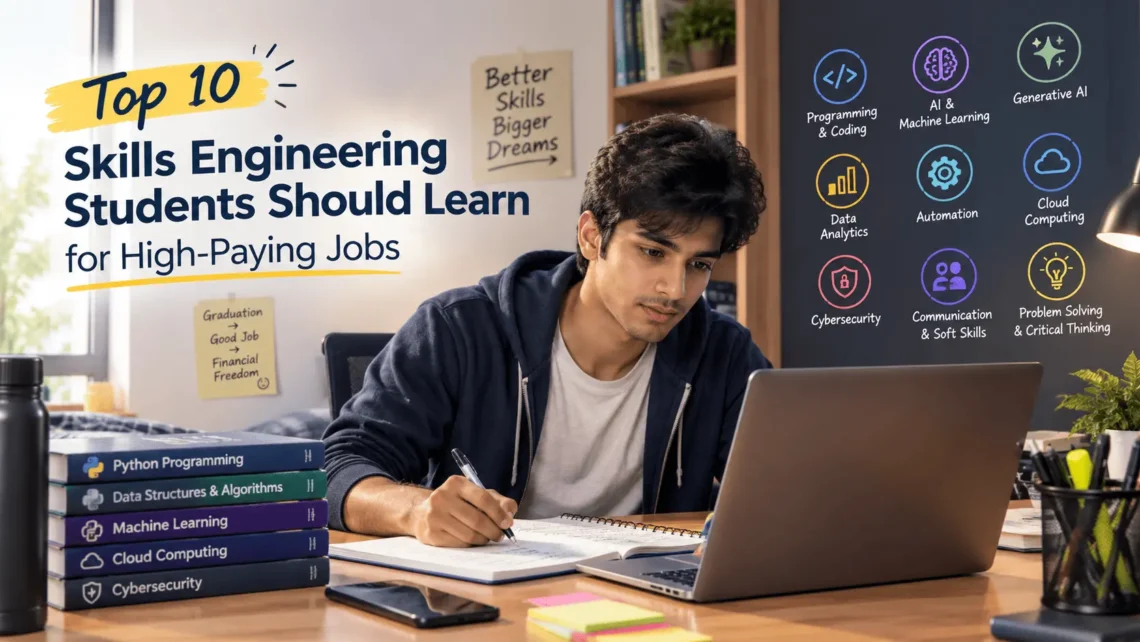
In this blog, we’ll look at 10 in-demand skills for engineering students, why they matter, where they can be applied, and how you can start developing them to stay prepared for the changing demands of the next years.
And this is not only relevant to computer science students. If you are a B.Tech, BCA, CSE, or engineering student from any branch, skills discussed in this blog can help you understand what employers may expect beyond your regular syllabus. A mechanical student may need automation skills, a civil student may work with data and software, while an electronics student may use programming and embedded technologies.
Table of Contents
Top 10 in-demand skills for engineering students in India
1. Programming & Coding
A common problem for engineering students is knowing programming concepts for exams but not knowing what to build with them. A student may understand loops, functions, and arrays, yet struggle when asked to write a small program without a lab manual. This becomes more noticeable during internships and placement interviews, where the question is often not “Do you know Python?” but “What have you built with it?”
The programming skills engineering students should learn start with one language and regular practice. Python is a useful starting point for students interested in data analysis, AI, automation, and general programming. Students who want to build a stronger foundation can explore a skill development Focus Python Training Course, while those interested in software development can consider a Java training.
Students who want to build websites can then explore web development.
When choosing the best programming languages for engineering students, the career path matters more than learning several languages at once. A student interested in AI may focus on Python, while someone targeting software development may add Java or another language used in their target role.
The coding skills needed for engineering jobs also include using code to solve small problems: cleaning a dataset, automating a calculation, processing a file, or building a simple application. These projects give students something concrete to discuss in interviews instead of only listing programming languages on a resume.
Students who need guided practice can consider an IT training institute that combines programming concepts with hands-on projects. A Java Training Course can help students strengthen their understanding of programming fundamentals while working on practical exercises and projects. The goal is not to collect certificates or learn every language, but to reach the point where you can take a problem, write a solution, test it, and explain how it works.
2. Artificial intelligence & Machine Learning (AI/ML)
An engineering student may use an AI-based system to monitor structures, predict equipment failures, or analyze production data without ever building the model behind it. The real challenge is knowing whether the result can be trusted. For example, a civil engineering student working with structural monitoring should understand what a model is checking when it flags a beam as high risk, what data it used, and why the prediction could be wrong. This basic understanding helps students work with AI tools without treating every output as automatically correct.
The AI skills engineering students should learn start with understanding how a model learns from past data, how incomplete or biased data can affect its results, and how predictions are tested. Students building the machine learning skills needed for engineering jobs should be able to explain why a model gives a particular result and identify when that result needs further checking. These fundamentals are also part of the AI skills needed for future engineering careers. Students who want guided learning can explore an AI and machine learning course that covers data preparation, model training, testing, and real-world applications.
3. Generative AI
Generative AI and machine learning are often grouped together, but they are used for different tasks. Machine learning can identify patterns in existing data and make predictions, while generative AI can create text, code, summaries, images, and other content from instructions. For an engineering student, this could mean using an AI tool to prepare a first draft of a lab report outline, explain a difficult technical concept, or review a piece of code, while keeping the actual technical work and final decisions under their own control.
The generative AI skills engineering students should learn include writing clear prompts, giving enough context, checking the output, and correcting information when needed. A prompt such as “explain thermodynamics” may give a broad answer, while a prompt that includes the topic, application, level, and required format can produce a more useful response. Building the GenAI skills for future engineering jobs also requires knowing when an AI-generated answer needs verification, especially for calculations, technical specifications, and engineering decisions. Students wondering how engineering students can learn generative AI can start with an AI and machine learning training program and then apply these tools to their own projects and coursework.
4. Data Analytics
Engineering students regularly deal with measurements, test results, production figures, survey data, and performance records. The difficulty often begins when a spreadsheet contains hundreds or thousands of values but there is no clear idea of what to look for. A production engineer, for example, could compare machine downtime by day and shift and discover that one machine has repeated failures at a specific time. That simple pattern can be more useful than looking through rows of numbers manually.
The data analytics skills engineering students should learn begin with organizing information, comparing results, identifying patterns, and presenting findings clearly. Students developing data analysis skills engineering students should learn should be comfortable with tasks such as filtering data, using pivot tables, creating charts, and understanding basic statistics before moving to more advanced analysis. Learning the data analytics tools engineering students should learn, such as Excel and Power BI, also gives students a way to turn a dataset into a dashboard or report that they can use in a college project, internship, or portfolio.
5. Automation
Many engineering students spend a lot of time repeating the same tasks without realizing that some of them can be automated. Copying data between Excel files, preparing regular reports, renaming documents, sending routine emails, or updating information across different applications can take hours when done manually. Learning how to identify these repetitive steps and reduce them can be useful in both college projects and future engineering jobs.
The automation skills engineering students should learn start with understanding how a task works from beginning to end. Students should be able to break a repetitive process into smaller steps and identify where code, scripts, or automation tools can take over. Basic programming can help with tasks that require more control, while no-code and low-code platforms can be useful for connecting different applications without writing everything from scratch. n8n, for example, can be used to connect different tools and create workflows that automatically move data, trigger actions, or send notifications when a specific event occurs.realising
Students interested in building these skills can explore an n8n automation course to learn how workflows are created and applied to everyday tasks. A simple project could collect information from a form, organise it in a spreadsheet, generate a report, and send a notification automatically using an n8n workflow. Working on projects like this helps students move beyond simply knowing what automation means and understand how it can reduce manual work, save time, and improve the way a process is handled.
6. Cloud Computing
Engineering projects often involve large files, shared datasets, simulations, applications, and documents that need to be accessed by several people. When team members keep sending different versions of the same file through email or messaging apps, it becomes easy to work on an outdated copy or lose track of the latest changes. Cloud computing helps solve this by allowing teams to store and access files, applications, and data from a shared online environment. An electrical engineering student working on a simulation project with teammates in different cities, for example, can work with the same set of project files without repeatedly exchanging updated copies.
The cloud computing skills engineering students should learn do not require students to become cloud architects. A basic understanding of cloud storage, databases, application deployment, access controls, and how online services work can provide a useful foundation for the cloud skills needed for engineering jobs. Students can begin exploring major cloud platforms engineering students should learn, such as AWS, Microsoft Azure, or Google Cloud, by deploying a simple website or application and learning how its files and data are managed online.
7. Cybersecurity
A college engineering project may involve sensors, applications, databases, or devices connected to the internet, but security is often considered only after something goes wrong. Leaving a default password unchanged, installing software without checking its source, or ignoring an available security update can create avoidable risks. These small oversights become more important when engineers work with IoT devices, industrial systems, networks, or cloud applications where one weak point can affect the wider system.
The cybersecurity skills engineering students should learn begin with everyday security practices such as using strong authentication, recognizing phishing attempts, protecting credentials, keeping software updated, and understanding basic network risks. These cybersecurity fundamentals engineering students should learn provide a foundation before moving into specialised security roles. The cybersecurity skills needed for IT jobs can also benefit students working in software, embedded systems, automation, or industrial engineering because connected systems are now part of many engineering environments.
8. Problem-Solving & Analytical Thinking
Engineering problems rarely arrive with the solution already defined. A simulation may show that a bridge design does not meet a required condition, a machine may produce inconsistent results, or a software project may fail without clearly showing where the problem began. In these situations, changing everything at once can create more confusion. Engineers need to examine the available information, isolate the likely cause, test possible solutions, and then decide what needs to be changed.
The problem-solving skills engineering students should develop are therefore closely connected with analytical thinking. The analytical skills needed for engineering jobs include breaking a larger problem into smaller parts, comparing possible solutions, considering factors such as cost and time, and checking whether the chosen solution actually works. Students can build critical thinking skills for engineering students through case studies, troubleshooting exercises, hackathons, technical projects, and internships where they have to work through problems without being given every step in advance.
9. Communication & Collaboration
Technical knowledge alone does not cover every situation an engineer faces at work. A student may understand how a system works but still struggle when asked to explain a project to a client, write a clear project update, or coordinate tasks with teammates from different backgrounds. Even a technically correct solution can cause delays when requirements are misunderstood or important information is not communicated clearly.
The communication skills engineering students need for jobs include writing clear emails and reports, presenting technical information, asking the right questions, listening to requirements, and explaining complex ideas without unnecessary jargon. The soft skills engineering students should develop also include teamwork, handling feedback, discussing disagreements, and keeping other team members informed about progress or problems. Developing workplace communication skills for engineers through group projects, presentations, internships, and technical discussions can make it easier to work effectively when projects involve people with different roles and levels of technical knowledge.
10. Project Management
A final-year engineering project can have a good technical idea and still run into problems when tasks are not divided properly. One team member may finish early while another is waiting for information, two students may unknowingly work on the same component, or an important task may be left until the deadline is close. These issues are often related to planning and coordination rather than technical ability.
The project management skills engineering students should learn start with simple practices such as dividing a project into smaller tasks, assigning responsibility, setting deadlines, tracking progress, and identifying possible delays early. The project management skills needed for engineering jobs also include basic resource planning and risk management, so students can recognise which tasks may affect the rest of the project if they fall behind. As they gain experience, students can explore project management tools engineering students should learn, along with basic Agile or Scrum practices, and apply them to college projects, internships, and team assignments.
What Skills Should Engineering Students Learn for Future Jobs?
Engineering students do not need to master all 10 skills at once. The best skills for engineering students to learn for future jobs depend on their branch, interests, and career direction. A CSE student may focus on programming, AI, or cybersecurity, while students from mechanical, civil, electrical, or other branches can combine their core engineering knowledge with skills such as data analytics, automation, cloud computing, or AI. Along with technical knowledge, communication, problem-solving, teamwork, and project management can help students handle real workplace situations more effectively.
For students wondering what skills engineering students should learn before graduation, the most useful approach is to learn one skill, practice it through a project, and gradually take on more challenging work. A student learning Python, for example, could automate a repetitive task, analyze a dataset, or build a small application and use that work to demonstrate their abilities during internships or placements. Building these job-ready skills for engineering students through projects and hands-on practice can help connect classroom learning with the skills employers expect from entry-level engineers.