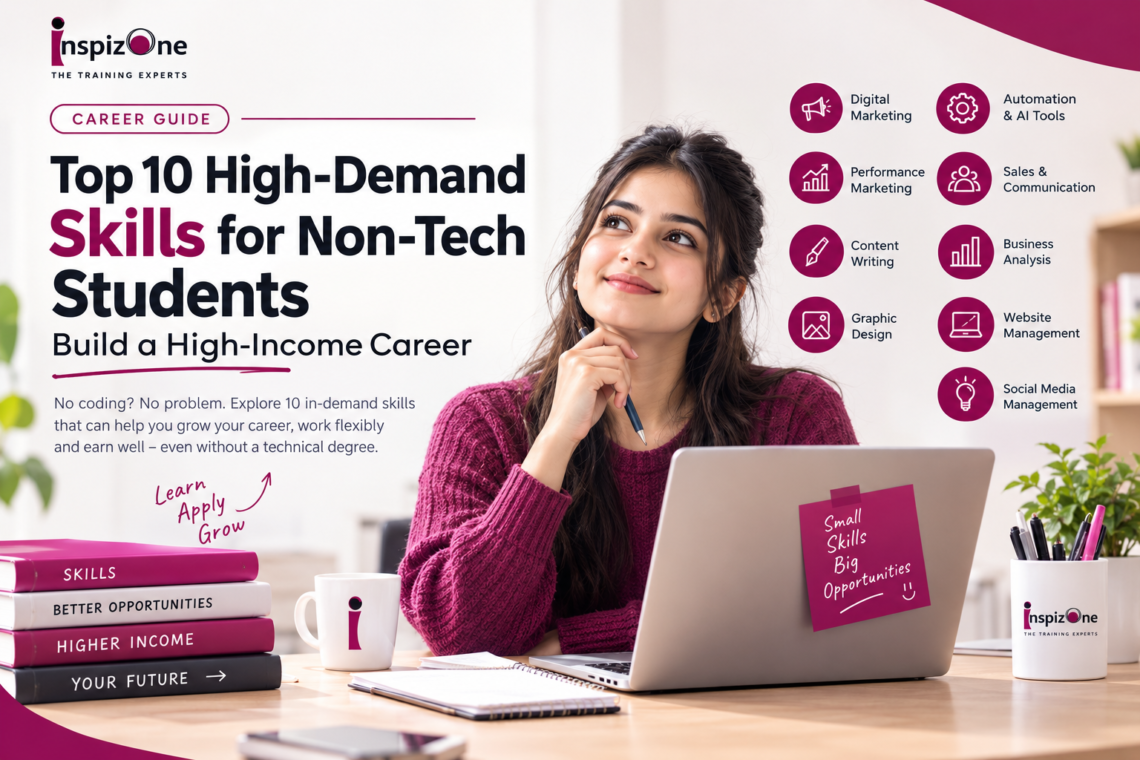
A student can finish college with a degree and still be unsure about what to do next. Online career advice often focuses on coding, AI, and software development, but these fields are not the right fit for everyone. If you are not interested in coding, there are still many career paths worth exploring.
A degree shows that you completed your education, but employers also look at what you can actually do. Many non-technical students assume that better-paying career options require programming skills. That is not always the case. Skills in marketing, design, writing, automation, sales, AI tools, and business analysis can also be used in digital and business roles without an engineering background.
This guide covers 10 High-Demand Skills for Non-Tech Students, with a focus on what each skill involves, where it is used, what beginners should learn first, and the types of jobs or freelance work it can support. No skill guarantees a specific salary or job. Your earning potential depends on factors such as your experience, portfolio, industry, location, and how well you apply the skill in real work.
Table of Contents
What Should Non-Technical Students Look for in a Career Skill?
Before choosing a skill, it is worth asking whether it will be useful in real work. A good skill should solve a business problem, be possible to learn without an engineering degree, and give you opportunities to work on real projects. It should also be useful across different industries, especially if you are still figuring out your career direction.
When looking at the Top 10 High-Demand Skills for Non-Tech Students to Build a High-Income Career, focus on skills that you can practise, show through a portfolio, and apply to real work instead of choosing one simply because it is trending.
Do You Need Coding to Learn a High-Income Skill?
This is usually the first doubt that comes up, and the answer is reassuring: not all high-paying skills require coding. Some rely on digital tools, some on communication, some on creative judgement, and some on the ability to read data and make a decision from it. A student weighing high-paying skills without a technical degree has more genuine options today than they might assume, since high-income skills that do not require coding span marketing, design, writing, and business roles that companies are actively hiring for right now. Anyone researching the best skills to learn without coding will find that most of them depend far more on consistent, applied practice than on technical complexity.
10 High-Income Skills for Non-Tech Students
WordPress Development with No-Code
Not every small business needs a website built from scratch, but most businesses still need a website that works well and looks professional. This is where WordPress development without coding can be useful. No-code WordPress development does not mean you need to know nothing about websites. It means using WordPress features, themes, plugins, and visual page builders instead of writing all the code yourself.
Learning this skill includes setting up WordPress, choosing and customizing themes, using page builders, creating site navigation and forms, applying basic SEO, configuring plugins, making pages mobile-friendly, and handling basic maintenance, security, and backups.
Students learning no-code WordPress skills for beginners can build a working website while they learn. A simple demo site can also become part of a portfolio and show potential clients what they can create. These skills can be useful for WordPress freelancing, website support, website management, and building websites for small businesses.
The best way to learn WordPress is to build an actual website instead of only watching tutorials. A practical WordPress training course can give learners the chance to create and manage a site while learning each part of the process.
n8n Automation
Many businesses spend hours on repetitive tasks such as moving data between tools, updating spreadsheets, sending notifications, processing form submissions, and following up with leads. These tasks may seem small, but they can take up a significant amount of time. n8n automation skills can help reduce this manual work by connecting different tools and automating routine processes.
n8n uses workflows to connect a trigger with one or more actions. For example, when a customer submits a form, the information can be sent to a CRM automatically. The sales team can receive a notification, and a follow-up email can be sent without someone handling each step manually.
Someone learning n8n workflow automation for beginners can start by creating simple workflows and learning how triggers, actions, applications, webhooks, and data transfer work. As they gain experience, they can add conditions and AI-based steps to handle more complex processes.
You do not need to be a traditional programmer to start with n8n. Much of the work involves understanding a business process and deciding which steps can be handled automatically. These skills can be useful for automation, operations, marketing, and business process roles. They can also be offered as a freelance service to businesses that want to reduce repetitive work. A beginner n8n automation course can provide hands-on practice by helping learners build and test their own workflows.
Master Generative AI Tools
Many students already use AI tools for quick questions, but using them for actual work requires a different set of skills. Generative AI skills for non-technical students are not just about writing prompts and getting answers from a chatbot. The useful skill is knowing how to use AI as part of a real task to save time or improve the work.
This can include writing clear prompts, using AI for research, working with documents, creating presentations and images, handling basic data tasks, and checking AI-generated information before using it. AI tools can produce incorrect information, so their responses should not be accepted without verification.
For example, a marketer can use AI to develop campaign ideas and draft content. An HR professional can use it to prepare job description drafts, while a salesperson can use it for prospect research. Content writers can use AI to support research and editing, and operations teams can use it for repetitive documentation.
Students exploring AI tools to learn for career opportunities should focus on how these tools can be used in real work situations. Practising with actual tasks is more useful than using AI only for casual questions. A task-focused Claude AI Course can help learners practise these applications.
UI/UX Designer
An app can work perfectly on a technical level and still leave every person who uses it frustrated. That gap between “it works” and “it works well for a person” is exactly what UI UX design skills are meant to close. UX covers how a product actually feels and functions for someone using it, while UI covers how the interface looks and communicates information visually. The two are related but distinct, and mixing them up is one of the most common early mistakes.
A student developing UI/UX design skills for non-technical students typically starts with user research, mapping out user journeys, building wireframes, structuring information clearly, creating prototypes in tools like Figma, running basic usability tests, and learning foundational design principles around spacing, hierarchy, and color. What makes this skill genuinely portfolio-ready is picking a real, familiar product and redesigning it: a college website, a food delivery app screen, a banking app flow, or an e-commerce checkout process. Redesign work like this shows an actual thought process, not just familiarity with a design tool’s toolbar.
Performance Marketing
Digital marketing covers many areas, while performance marketing focuses on measurable results. Performance marketing skills are mainly about understanding what a campaign achieves and how much it costs. Instead of only looking at how many people saw an ad, marketers track spending, responses, leads, conversions, and the performance of different ads.
For someone learning performance marketing skills for beginners, platforms such as Google Ads and Meta Ads are useful starting points. You need to learn how to set campaign goals, choose the right audience, create and test ads, and set up conversion tracking. You should also understand metrics such as CPC, CTR, CPA, and ROAS because they help you see whether a campaign is working.
Practice is important when learning performance marketing. A small test campaign can help you understand how changes in the audience, ad copy, or creative affect the results. Looking at the campaign data afterwards can show you what worked, what did not, and what could be changed in the next campaign.
Digital Marketing
A business can have a great product and still struggle to reach customers if the right people do not know it exists. This is where digital marketing skills for non-tech students can be useful. Digital marketing covers several areas, including SEO, social media, content, email marketing, paid advertising, analytics, and conversion optimization. Each area helps a business reach potential customers, build interest, and turn that interest into sales.
The basic process is simple: reach the right audience, get their attention, provide useful information, encourage them to take action, and keep them coming back. For someone looking for the best digital marketing skills to learn for career growth, a good starting point is keyword research, basic SEO, content planning, social media marketing, Google Ads, and analytics. These skills help you understand how online campaigns work and how to check whether they are producing results.
These skills can lead to roles such as digital marketing executive, SEO specialist, social media specialist, content marketer, marketing coordinator, or freelance marketer. They can also be used across different industries, including retail, education, and healthcare. Working on real campaigns and projects can help you understand the work better than studying theory alone. A hands-on digital marketing course can provide an opportunity to practise these skills through real projects.
Data Analytics
Businesses collect a lot of data, but the data itself does not answer business questions. Someone needs to examine it, find useful patterns, and explain what the numbers mean. This is where data analytics skills for non technical students can be useful. Data analytics is not just about creating charts. It involves using data to answer specific questions and support business decisions.
For example, saying that sales decreased by 12 percent does not explain what happened. An analyst would look at which product had lower sales, which location was affected, which customer group showed the change, and when the decline started. They may also compare the data with changes in pricing, promotions, or other business activities during that period.
Students looking to build data analytics skills to learn for career growth can start with Excel, data cleaning, basic statistics, SQL, Power BI, data visualization, dashboard creation, and business reporting. These skills are useful for roles such as data analyst, reporting analyst, business analyst support, MIS and reporting, and marketing analytics.
Content Writing & Copywriting
Every business needs written content for websites, blogs, product pages, emails, advertisements, social media, and landing pages. However, content writing and copywriting have different purposes. Content writing usually focuses on informing or educating readers and helping a website gain visibility through useful content. Copywriting focuses on encouraging the reader to take an action, such as clicking a link, making a purchase, or signing up.
Building copywriting skills for digital marketing involves learning how to research a topic and audience, organize information, write clear SEO-friendly content, create useful headlines, and write landing pages, product descriptions, emails, and calls to action. Editing is also an important part of the process because the first draft is rarely the final version.
AI writing tools can help with ideas, outlines, and early drafts, but they do not replace research or editing. A good writer still needs to check facts, understand the audience, and make sure the final content is clear and relevant.
E-commerce & Affiliate Marketing
Many people are interested in starting an online business but are not sure how products, customers, website traffic, and sales connect. E-commerce and affiliate marketing skills cover two different ways of working with online businesses.
E-commerce involves tasks such as researching products, setting up an online store, writing product descriptions, setting prices, managing orders, improving the customer experience, tracking sales, and improving conversions. Affiliate marketing focuses on choosing a niche, researching keywords, creating useful content, bringing visitors to a website, comparing products, tracking affiliate links, and checking which content leads to sales.
Anyone learning affiliate marketing skills for beginners should have realistic expectations. Affiliate marketing does not guarantee passive income. Results usually depend on building regular traffic, earning the trust of an audience, publishing useful content, choosing suitable products, and improving conversion rates over time. These results can take months to develop.
Business Development
A good product still needs the right customers. Business development focuses on finding potential customers, starting conversations, understanding their needs, and turning genuine interest into business opportunities. Business development skills can be useful for non-technical students who prefer communication, sales, and relationship-building work.
Learning these skills includes lead generation, prospect research, professional communication, sales calls, client relationship management, proposal writing, basic negotiation, CRM tools, and follow-up. Following up on time is an important part of the job because potential deals can be missed when communication stops after the first conversation.
Students building business development skills for beginners can explore roles such as business development executive, sales development representative, account executive, or partnership executive. These roles require clear communication, regular follow-up, and the ability to build professional relationships.
Are High-Income Skills Without Coding Actually Possible? (Let's Understand How)
Coding is useful for many careers, but it is not required for every digital role. Many jobs depend more on communication, creativity, marketing, analytical thinking, business knowledge, or the ability to use digital tools. This means students looking for high-income skills without a technical degree have several options to consider.
The earning potential of high-income skills that do not require coding depends on factors such as experience, specialization, portfolio, industry, and location. A skill itself does not guarantee a high income. Students choosing the best skills to learn without coding should consider whether the skill matches their interests, can be used in real jobs, and offers opportunities to build relevant experience.
Final Takeaway
A non-technical background does not limit you to a small number of career options. Instead of focusing only on which skill pays the most, consider whether the skill matches your strengths, has real workplace applications, and can be demonstrated through projects or other work.
A simple path is to choose one skill, learn the basics, practise it, build a portfolio, and gain experience. Focusing on one area at a time can be more useful than trying to learn several skills at once.
For engineering students, the right skill set can also make a difference in career preparation. If you’re interested in exploring relevant options, read our guide on skills engineering students should learn for high-paying jobs.