
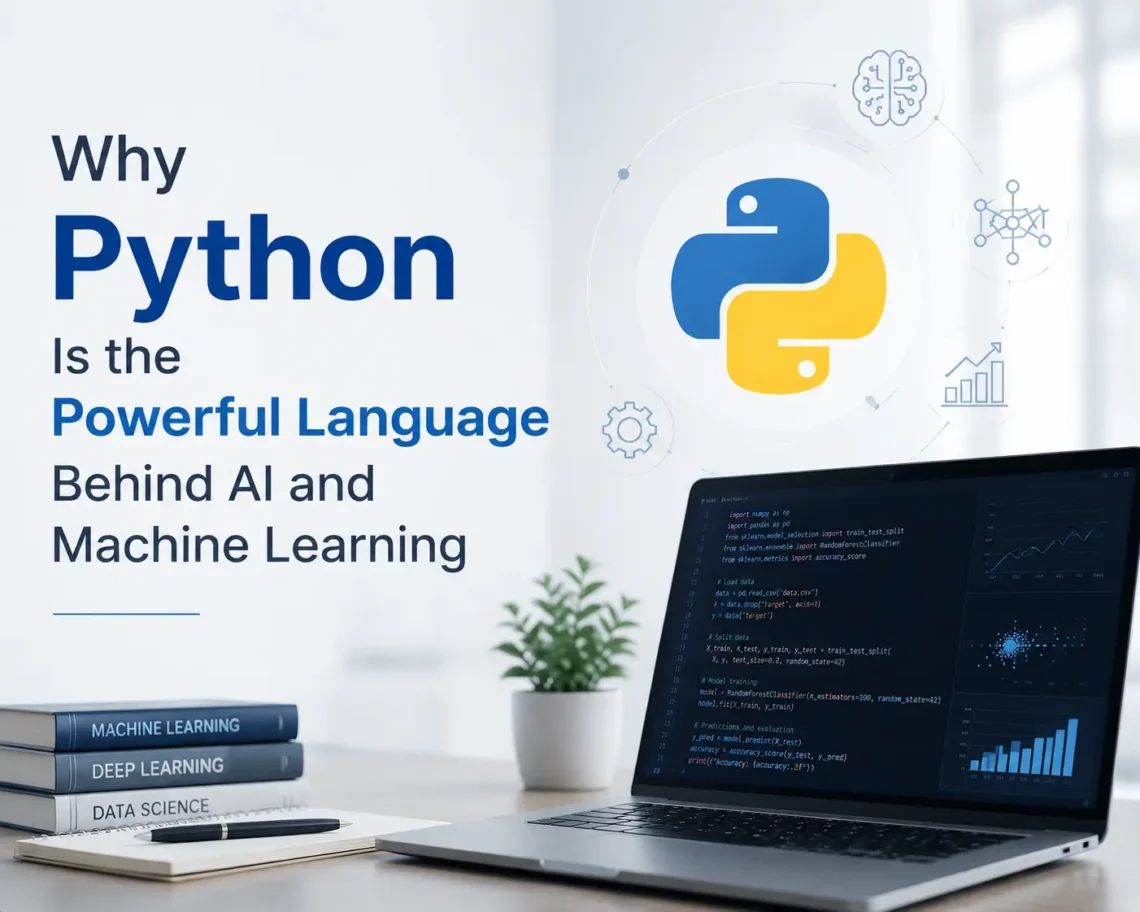
Why Python Is the #1 Programming Language for AI and Machine Learning
Python for AI and machine learning has become the standard choice among developers, researchers, and beginners entering the field. Artificial intelligence and machine learning now shape industries ranging from healthcare to finance, and demand keeps growing for a programming language that balances simplicity with power. Python fits this need closely, offering a readable syntax alongside an ecosystem built specifically for data-driven and AI-based development. This growing adoption is not limited to big technology firms. Students, career switchers, and independent developers increasingly turn to Python as their entry point into AI, mainly because it removes much of the complexity tied to traditional programming languages.
What Is Artificial Intelligence?
Artificial intelligence refers to the ability of a computer system to perform tasks that typically require human intelligence. This includes recognising patterns, making decisions, understanding language, and improving performance based on past data.
A few familiar examples help illustrate this:
- Voice assistants that understand spoken commands and respond accordingly
- Recommendation systems that suggest content or products based on user behaviour
- Navigation tools that predict the fastest route using current traffic data
These systems rely on models trained on large volumes of data, and Python plays a central role in building, training, and deploying such models.
What Is Machine Learning and How It Differs From AI?
Machine learning is a subset of artificial intelligence that focuses on training systems to learn from data rather than following fixed rules. Instead of programming every outcome directly, developers feed data into a model, and the model adjusts itself to improve accuracy over time.
Two common approaches exist within machine learning:
- Supervised learning: the model learns from labelled data, similar to a student learning from a solved example before attempting a new question.
- Unsupervised learning: the model finds patterns in unlabelled data on its own, similar to sorting a mixed basket of fruit into groups without being told which fruit belongs where.
This distinction shapes how a system is trained and what kind of data it needs before it becomes useful in a working application.
Why Python Is Used for AI and Machine Learning
Python holds a strong position in AI and machine learning development for several practical reasons.
Simple and Readable Python Syntax
Python’s syntax stays close to plain English, which lowers the entry barrier for beginners. A task that might need many lines of code in a language like Java or C++ often takes far fewer lines in Python. This lets new learners focus on understanding AI concepts instead of struggling with complicated code structure.
Wide Range of Python Machine Learning Libraries
Python’s library support is one of the biggest reasons it holds ground in AI development. These libraries cover everything from data cleaning to building deep learning models.
Library | Purpose |
NumPy | Numerical computation |
Pandas | Data handling and analysis |
Matplotlib | Data visualisation |
Scikit-learn | Traditional machine learning |
TensorFlow | Deep learning |
PyTorch | AI model building |
OpenCV | Computer vision |
NLTK | Natural language processing |
Each library covers a specific stage of AI development, so developers rarely need to build core functions from the ground up.
Faster Development Cycles
Because Python code is shorter and simpler to write, developers can build and test AI models faster than in many other languages. This matters in AI work, where testing and adjusting models happens many times before a version is ready.
Strong Python Community and Documentation Support
Python has one of the largest open-source communities among programming languages. Long-standing forums, detailed documentation, and shared code examples make it easier to solve problems during development, especially for beginners without a mentor nearby.
Python Adoption Across Major Industries
Python is used across a wide range of sectors, including technology, finance, healthcare, and research. This spread happens because AI applications built in Python can move from research to a working product with fewer changes to the underlying code.
Applications of Python in AI
Machine learning is a subset of artificial intelligence that focuses on training systems to learn from data rather than following fixed rules. Instead of programming every outcome directly, developers feed data into a model, and the model adjusts itself to improve accuracy over time.
Industry | Application |
Healthcare | Disease prediction models |
Banking and finance | Fraud detection, algorithmic trading |
E-commerce | Product recommendation systems |
Education | AI-based tutoring tools |
Marketing | Customer segmentation |
Manufacturing | Predictive maintenance |
Cybersecurity | Threat detection |
Each language has its place. Java and C++ often get used where processing speed matters more than development time, and R remains common in statistics-heavy research. But for building and testing AI models quickly, Python’s combination of simple syntax and library support makes it the easier choice for most learners and teams
Essential Python Libraries for AI Beginners
For someone starting out, learning every available library at once is not needed. A focused set covers most beginner-level AI work:
- NumPy for numerical operations
- Pandas for organising and cleaning data
- Matplotlib for basic data visualisation
- Scikit-learn for traditional machine learning tasks
- TensorFlow or PyTorch for deep learning, once the fundamentals are in place
Starting with these five gives a learner enough working knowledge to build small projects before moving into more specialised tools.
Python vs Java and Other Programming Languages for AI
Feature | Python | Java | C++ | R |
Ease of learning | High | Moderate | Low | Moderate |
AI library support | Wide | Limited | Limited | Strong (statistics) |
Community support | Large | Large | Large | Moderate |
Development speed | Fast | Slower | Slower | Moderate |
Each language has its place. Java and C++ often get used where processing speed matters more than development time, and R remains common in statistics-heavy research. But for building and testing AI models quickly, Python’s combination of simple syntax and library support gives it a clear edge for most learners and teams.
Can Beginners Learn AI Using Python
Many people assume AI requires a computer science background or years of coding experience before it can be attempted. This is not accurate for Python for beginners AI learning specifically.
A few points worth understanding before starting:
- No prior coding experience is required to begin. Python’s syntax is one of the easier starting points among programming languages.
- A computer science degree is not a requirement. Many working AI practitioners come from mathematics, statistics, business, or entirely unrelated fields.
- Basic maths helps but is not a blocker at the start. Concepts like statistics and linear algebra become more relevant once a learner moves into model-building, not at the very beginning.
What matters more than background is consistent practice and working through hands-on examples rather than only watching tutorials. For learners who prefer a guided structure over self-study, a python training course can cover these fundamentals in a set sequence, with feedback built into each stage.
A Practical Python Learning Path for AI and Machine Learning
A structured progression works better than jumping straight into advanced topics. A typical path looks like this:
- Python fundamentals (syntax, data types, loops, functions)
- Data structures (lists, dictionaries, sets)
- NumPy for numerical operations
- Pandas for data handling
- Data visualisation with Matplotlib
- Machine learning basics with Scikit-learn
- Deep learning with TensorFlow or PyTorch
- Generative AI concepts
- Projects and portfolio building
Each stage builds on the one before it, and skipping ahead too early is one of the most common reasons beginners get stuck. Learners based in Uttar Pradesh looking for local, in-person support can also look at what makes a python training course in Lucknow worth considering before choosing where to start.
Common Mistakes Beginners Make
A few patterns show up often among beginners struggling to progress in AI:
- Jumping straight to TensorFlow or PyTorch before understanding Python basics or NumPy and Pandas. This usually leads to confusion that has nothing to do with AI itself, just with unfamiliar code.
- Skipping Python fundamentals to reach the AI part faster, which slows progress later since every AI library sits on top of core Python knowledge.
- Watching tutorials without writing code. Watching a video on model training does not build the same understanding as building one, even a small one.
- Not building projects. A learner who only follows along with existing examples struggles when faced with a new, unfamiliar problem.
- Inconsistent practice. AI concepts build on each other, and long gaps between sessions mean earlier concepts get forgotten before the next stage begins.
Avoiding these patterns matters more than any single library or tool choice.
Conclusion: Why Python Leads AI and Machine Learning Development
Python’s position as the top choice for AI and machine learning comes down to a combination of factors: simple syntax, many purpose-built libraries, fast development cycles, and a large community that supports learners at every stage. From healthcare to finance to manufacturing, its use across so many industries reflects how well it fits both research and production needs.
For beginners, the path into AI does not require a computer science background or years of prior coding experience. What it needs is a structured start, consistent practice, and hands-on projects rather than passive learning. With the right foundation in Python, moving into machine learning and eventually deep learning becomes a manageable, step-by-step process.




Experience the excitement of betting at zoome casino, zoome casino, where thrilling games await you.
Join today and discover exclusive bonuses. Don’t miss the chance
to earn big!
Look at my web page :: https://zoome-casinos-aus.com
This emerging movement of digital gambling has led to the rise of clubhouse casino, clubhouse casino, providing new possibilities for players.
My homepage; https://the-clubhousecasino-au.com
Honestly the best experience I have had in a long time. The bonuses are actually generous and the games load instantly. Definitely sticking with 5k5k777 from now on.
The graphics are top notch and the spin mechanics feel very fair. It’s a great way to unwind after a long day of work. Love inyunoslot
[9247]xsmbkt – Đăng nhập tải app game bài đổi thưởng uy tín,xsmbkt là sòng bài live casino uy tín, hỗ trợ game bài đổi thưởng qua momo nhanh chóng. Hướng dẫn cách chơi baccarat trực tuyến chi tiết. Truy cập ngay! visit: xsmbkt
Really impressed with the variety of games available. Everything loads fast and the graphics are top notch. Glad I found br456bt.
The app version is a game changer. I can play anywhere and it doesn’t crash. If you prefer mobile gaming, ok777betapp is the way to go.
Honestly, I’ve tried a few sites but this one is super smooth. The payouts are fast and the interface is just easy to use. Definitely my new go-to spot! krkcwin20
The graphics are stunning and the gameplay is just addictive. I really appreciate the security measures they have in place. Visit idroyalsensa.